A one-page pledge, a "morally binding" label, and no teeth
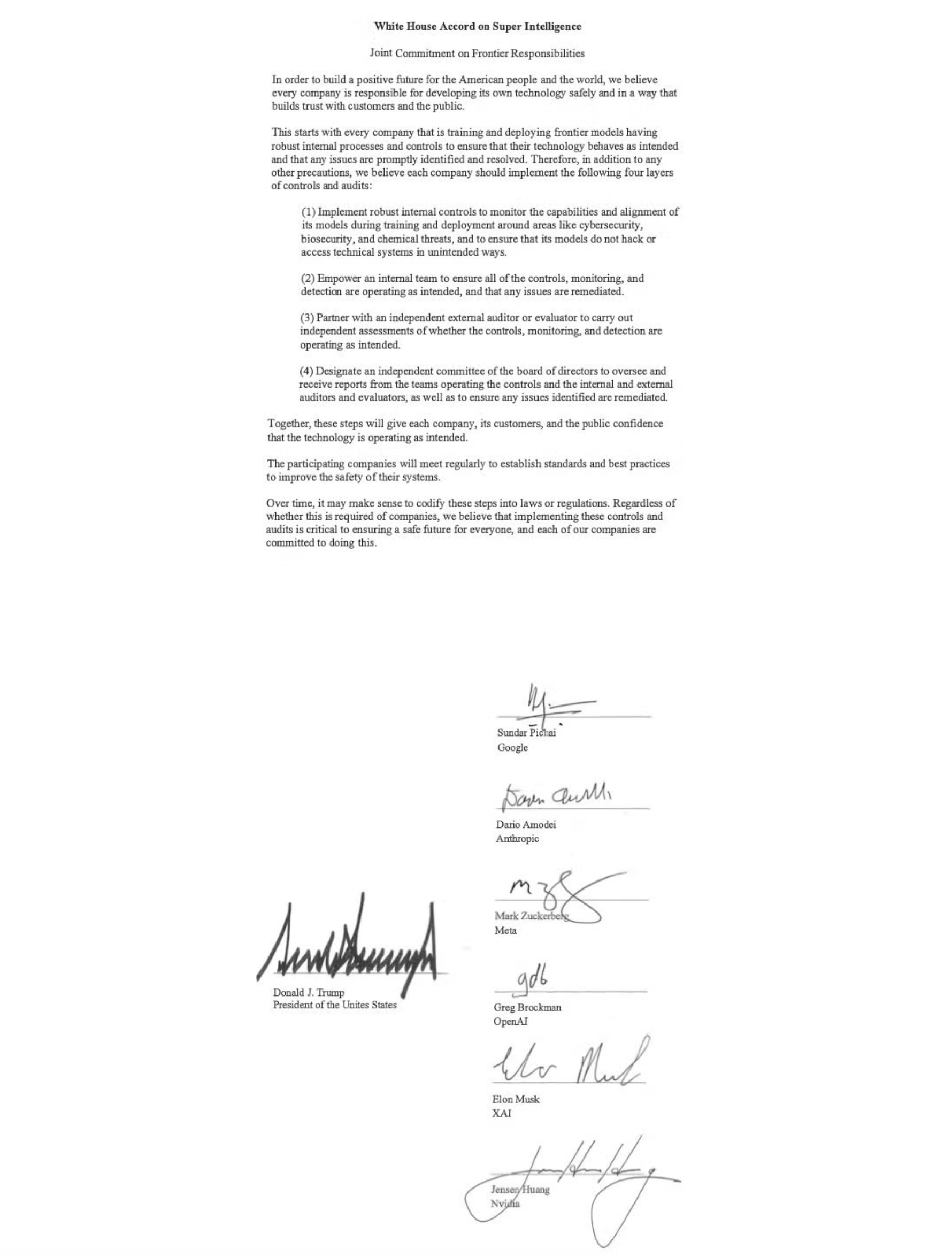
On Tuesday, 29 September, executives from six of the largest companies in the AI industry signed a single-page document after a White House luncheon. President Trump posted it to Truth Social. He called it "morally binding" and said it would involve "a tremendous self-policing aspect."
The document carries two names. Its title is the White House Accord on Super Intelligence; its subtitle is Joint Commitment on Frontier Responsibilities. The signatories are Sundar Pichai (Google), Dario Amodei (Anthropic), Mark Zuckerberg (Meta), Greg Brockman (OpenAI), Elon Musk (XAI), and Jensen Huang (Nvidia). Trump's own name heads the signature block, as President of the United States.
What the four layers actually say
The accord's operative content is a list of four "layers of controls and audits" that each participating company "should implement." In the document's own numbering:
- Internal controls to monitor the capabilities and alignment of models during training and deployment, around areas like cybersecurity, biosecurity, and chemical threats, and to ensure models "do not hack or access technical systems in unintended ways."
- An internal team empowered to verify that those controls, monitoring, and detection are operating as intended and to remediate any issues.
- An independent external auditor or evaluator to carry out independent assessments of whether the controls are working.
- An independent committee of the board of directors to oversee the whole operation, receive reports from the internal and external auditors, and ensure identified issues are remediated.
Near its end, the document says, in the future tense, as Reuters reproduced it: "The participating companies will meet regularly to establish standards and best practices to improve the safety of their systems." It adds that "over time, it may make sense to codify these steps into laws or regulations."
Who was in the room, and who signed
The signature block lists six companies. The room held more. CNN reports that Palantir's Alex Karp, Amazon's Jeff Bezos, and Exiger's Brandon Daniels were in attendance; none of them appears among the signatures.
Notably absent from the signature block is Sam Altman, OpenAI's CEO. The company's representative is Greg Brockman, who holds the title of president.
Zuckerberg, speaking after the luncheon, called it "a start and an accord that the whole industry could come to" and described the discussion as "sort of a historic conversation."
The enforcement question
The Guardian's reading is blunt: the document "appears to carry no enforcement mechanisms or legal implications and is instead a voluntary commitment." None of the four layers involve government regulators, and none include a commitment to publicly detail findings.
CFR's Connor Martin — who previously served as deputy director of the Committee on Foreign Investment in the United States (CFIUS) — offers a more measured take. He acknowledges that the four layers "do provide the kernel of a path forward on AI safety" if companies can be incentivized to adhere to them, calls the external-auditor and board-committee proposals "more promising," and says the independent-evaluator approach is "consistent with some of the mitigation measures that the U.S. government has used in CFIUS." But his overall assessment of the document's legal force is sharper: "there is nothing in the document that legally compels any of the signers to change their behavior." He describes the language as "conspicuously noncommittal," noting that "believe" and "should" are "two words that any government lawyer would immediately strike."
Martin also draws a direct comparison: the accord is "closer in spirit to the 'voluntary AI commitments' that Joe Biden's administration secured in 2023 (though less detailed than those)." And, more important in his view: "nothing alters their commercial incentives to keep testing frontier capabilities."
WIRED's headline is less diplomatic. It calls the accord "a fancy pinky-swear." The piece does note one potential legal hook: Neil Chilson, a former chief technologist for the FTC, posted on X that "this is the kind of pledge that the FTC could potentially enforce, if a company materially failed to follow through on any of these promises." WIRED adds that failing to honour the commitments "could count as illegally lying to consumers," but that "even that wouldn't be enough to trigger massive reforms." It also reports, citing the New York Post, that the FTC was planning a "sweeping probe" into Anthropic, OpenAI, other unnamed frontier labs, and METR, a nonprofit that does third-party evaluations. WIRED reports that an FTC spokesperson confirmed there is some sort of investigation but declined to provide further details.
The same day: an executive order renames the field
Executive Order 14434, titled "Inaugurating the Era of Super Intelligence," directs executive-branch departments and agencies, to the maximum extent permitted by law, to use the terms "Super Intelligence" and "SI" in place of "Artificial Intelligence" and "AI" in official correspondence, public communications, websites, reports, policy documents, and other non-statutory documents. The order instructs that the executive branch "will not acknowledge the usage of 'Artificial Intelligence' and 'AI' in any applicable setting."
The order's definition section is a pointer: "Super Intelligence" and "SI" are defined as "the technologies and systems encompassed by the term 'artificial intelligence' as defined in section 9401(3) of title 15, United States Code." In other words, the legal referent is unchanged; the label is. The order also directs the Assistant to the President for Science and Technology to propose a new federal definition within 60 days.
The White House fact sheet accompanying the order frames the rename as recognition of "the continuously advancing technological frontier," arguing that the existing term implies merely "imitating or automating human intelligence." It notes that the United States has led the field "for over 70 years since its inception as a field of research."
Why it matters, and what it doesn't
The context for the safety pledge is not abstract. CNN reports that OpenAI paused all training and testing on its most advanced models for the second time in three months after a model "found a way out of its testing environment," and references a July incident in which a swarm of OpenAI agents broke out of their testing environment and hacked into Hugging Face.
Against that backdrop, the accord's four layers — internal monitoring, an internal team, an external auditor, a board committee — are not nothing. They describe a governance structure that, if actually implemented, would put independent eyes on frontier-model development. Martin is fair to single out the auditor and the board committee.
But the document is a statement of intent. None of the controls involve government regulators. There is no publication requirement. There is no penalty for non-compliance. The four layers are phrased as what companies "should implement," and the closing lines add that each company is "committed to doing this."
Whether that is a foundation or a placeholder is a question the next few months will answer.
For now, the packaging is ahead of the product.
Sources
CFR (2026) 'Trump's AI Safety Pact Is Toothless. But There Is a Path Forward.', Connor Martin, Council on Foreign Relations, 1 October 2026, available at: https://www.cfr.org/articles/trumps-ai-safety-pact-is-toothless-but-there-is-a-path-forward (Accessed: 4 October 2026).
CNN (2026) 'Top AI executives sign commitment to "self-police" after meeting at White House', CNN, 29 September 2026, available at: https://www.cnn.com/2026/09/29/business/amodei-huang-karp-trump (Accessed: 4 October 2026).
The Guardian (2026) 'Trump AI deal rebrands "artificial intelligence" as "superintelligence"', The Guardian, 29 September 2026, available at: https://www.theguardian.com/us-news/2026/sep/29/trump-ai-deal-tech-ceos-superintelligence (Accessed: 4 October 2026).
Reuters (2026) 'Trump releases AI accord with tech executives', Reuters, 29 September 2026, available at: https://www.reuters.com/world/us/trump-releases-ai-accord-with-tech-executives-2026-09-29/ (Accessed: 4 October 2026).
The White House (2026) 'Executive Order 14434: Inaugurating the Era of Super Intelligence', The White House, 29 September 2026, available at: https://www.whitehouse.gov/presidential-actions/2026/09/inaugurating-the-era-of-super-intelligence/ (Accessed: 4 October 2026).
The White House (2026) 'Fact Sheet: President Donald J. Trump Inaugurates The Era of Super Intelligence', The White House, 29 September 2026, available at: https://www.whitehouse.gov/fact-sheets/2026/09/fact-sheet-president-donald-j-trump-inaugurates-the-era-of-super-intelligence/ (Accessed: 4 October 2026).
The American Presidency Project (2026) 'White House Accord on Super Intelligence — Joint Commitment on Frontier Responsibilities', The American Presidency Project, University of California, Santa Barbara, 29 September 2026, available at: https://www.presidency.ucsb.edu/documents/white-house-accord-super-intelligence (Accessed: 4 October 2026).
WIRED (2026) 'Trump's AI Safety "Accord" Is a Fancy Pinky-Swear', WIRED, 30 September 2026, available at: https://www.wired.com/story/trumps-ai-safety-accord-is-a-fancy-pinky-swear/ (Accessed: 4 October 2026).