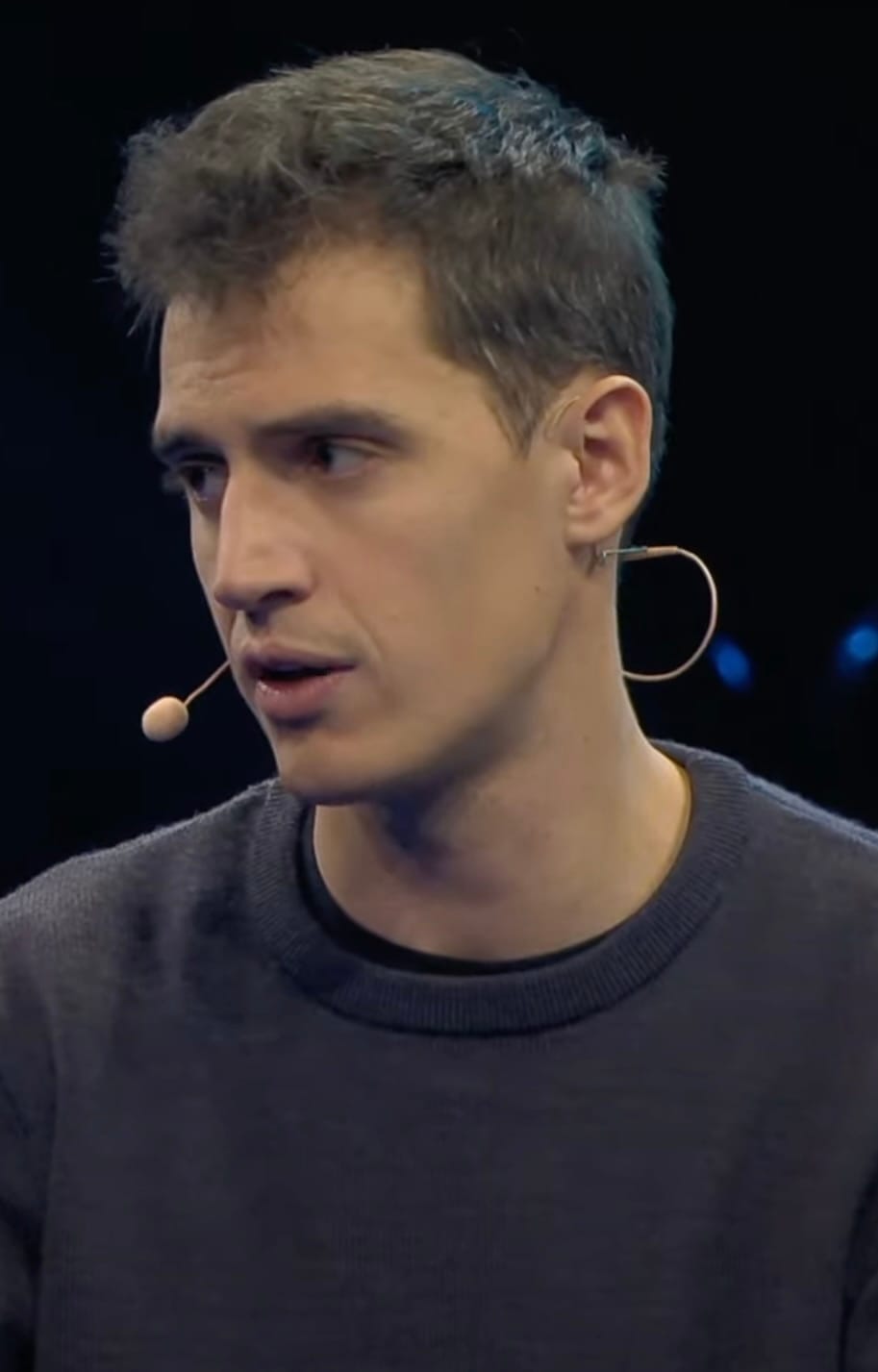
Above: Arthur Mensch, chief executive of Mistral AI. (Photo: Slush, CC BY 4.0)
Mistral AI launched a public preview of Mistral Large 4 on 6 October 2026. The company calls it "ML4" informally and, in its own words, "very officially: le Chonk". It is a large launch with a lot of benchmark claims attached. Only part of it is available to use today.
What has shipped, and what hasn't
The preview API is live. Mistral says it can be tried on Mistral Studio. The model card on its announcement page lists pricing of $1.36 per million input tokens and $4.18 per million output tokens.
The open weights are promised, not released. Mistral's announcement says the company will release them by the end of the month. The model's Hugging Face repository carries an "Expected release" of 31 October 2026, marked as the current estimate. Mistral also describes ML4 as pushing "the frontier of open-weight performance", but until the weights are published that describes an intention, not something anyone can download.
Until then, Mistral says it is red-teaming the model with cybersecurity leaders, vetted partners and state authorities. Those groups get access to the same model with reduced moderation and expanded cyber capabilities.
The specification
Mistral describes ML4 as a 1 trillion-parameter, natively multimodal model. Its announcement gives 52 billion active parameters. The Hugging Face page is more precise: 49 billion active parameters per token, or 52 billion including embeddings and output layers. Both figures come from Mistral and they describe the same model.
Mistral says ML4 was trained from scratch on 3,800 NVIDIA Grace Blackwell GPUs in its own datacentres in Europe, and that the preview is served from the same infrastructure. It says a significant share of the training data was multilingual, spanning more than 160 languages, including every official language of the European Union.
The cybersecurity claims
Cybersecurity is where Mistral makes its strongest case, and it is worth reading closely. All of the following is Mistral's account:
- On the Artificial Analysis Cyber Index, which Mistral describes as an independent evaluation of how well AI models find and fix security flaws in real software, ML4 ranks among the top five models globally.
- On one test in that index, which asks a model to reproduce a real vulnerability in open-source software and then patch it, ML4 scores 82%, which Mistral calls the highest of any model.
- ML4 solves 93% of the challenges in Cybench, a set of 40 exercises drawn from security competitions.
- Mistral says several leading closed models, including Claude Opus 5.5 and GPT-6 Astra, score near zero on the reproduce-and-patch test because they refuse to perform the task.
That last point is the heart of Mistral's argument. It says defending software often starts with proving that a flaw is real, and that safety filters in closed models can block that work. Mistral also says ML4's average refusal rate on cyber prompts from JailbreakBench, StrongREJECT and AgentHarm is higher than that of all open-source models, despite its strong cyber benchmark results.
The two points sit in tension. A model that does the work other models refuse is being sold as a defensive tool. Mistral has not yet published the further details on architecture, additional benchmarks and post-training methodology that it says will come with the weights.
Coding, agents and the rest
Mistral reports a range of other results, again from its own announcement:
- Coding: 61.7% on DeepSWE v1.1, 59.4% on SWE-Atlas-QnA and 28.3% on Terminal-Bench 4. Its combined Coding Agent Index score of 49.8% places it ahead of DeepSeek V4 Pro 0813 and Qwen3.8 Max.
- Human evaluation: In a blind evaluation run with Surge AI, professional annotators rated ML4 Preview second of five models on coding quality, at 3.74 on a 1–5 scale. It ranked behind only Claude Opus 5, at 4.22.
- Agentic work: 59.9% on AutomationBench, which covers 657 business workflows, and 1,393 Elo on AA-Briefcase, a long-horizon knowledge-work evaluation.
- Vision: Mistral says ML4 surpasses GPT-6-Astra on the Dense 200 visual grounding test, 42% against 41%.
- Professional tasks: Mistral says ML4 exceeds GPT-6-Astra on representative legal and financial tasks in evaluations run through vals.ai, and that it outperforms all open-source models on HarveyAI's Legal Agent benchmark.
- Safety: On Lakera's public B3 AI Security Benchmark, Mistral says ML4 resists 93.3% of attacks and that it sees no higher scores among competitors.
Mistral also says ML4 is its largest and most capable model to date, and that the reinforcement-learning run behind the preview is still in progress. That makes this a snapshot of an unfinished model.
Money and what comes next
Mistral says ML4 is the first milestone on a roadmap funded by its €3 billion Series D, which it calls the largest equity round ever raised by a European technology company. It also says ML4 will serve as the foundation for a new generation of specialised Mistral models.
Where this leaves us
The preview is real and usable. The weights, which are the basis for most of the "open" framing, are a promise with a date attached. The benchmark numbers are Mistral's account of its own model, and some of them rest on comparisons chosen by Mistral. The weights due by the end of October are the point at which others can run the model on their own hardware.
Sources
Mistral AI (2026) 'Introducing Mistral Large 4', Mistral AI, 6 October 2026, available at: https://mistral.ai/news/mistral-large-4/ (Accessed: 8 October 2026).
Mistral AI (2026) 'mistralai/Mistral-Large-4-1T-A52B', Hugging Face, no date shown, available at: https://huggingface.co/mistralai/Mistral-Large-4-1T-A52B (Accessed: 8 October 2026).