On 19 October 2026, Inception released Mercury 3, a diffusion-based language model. The company's launch post calls it "the most capable diffusion-based LLM released to date". The headline claims are speed, price and a benchmark lead over two fast rival models. Nearly all of the evidence comes from Inception itself. This piece separates what the company says from what others have reported.
A note on where we stand: this article was produced with AI tools that include Anthropic's Claude, and Inception compares Mercury 3 directly with Anthropic's Claude Haiku 5.5.
What Inception announced
Inception's post says that "Across a range of benchmarks, Mercury 3 outperforms GPT-6 Luna and Claude Haiku 5.5, while running 4–8x faster at 1,000+ tokens per second." Its "at a glance" box gives the figures:
- Speed: 1,068 tokens per second on NVIDIA GPUs.
- Context: 1M tokens, up from 260K for Mercury 2.5.
- Price: $0.20 per million input tokens and $0.70 per million output tokens. At launch the price is 50% off, at $0.10 and $0.35, and cached tokens are 90% off the input price.
Inception also says Mercury 3 is more than 40x larger than Mercury 1, and that intelligence across a range of standard benchmarks has risen 3x from Mercury 1 (mini) to Mercury 3. Its conclusion is that "The scaling laws that drove progress in autoregressive models hold for diffusion too." The post gives no parameter count.
A diffusion model does not write one token after another. Inception's Mercury 2 launch post, as quoted by On The Wire, says the approach "generates responses through parallel refinement, producing multiple tokens simultaneously", in contrast with "autoregressive, sequential decoding".
Inception's Mercury 3 post says Mercury 3 is available through the Inception API Platform, OpenRouter, Baseten and Vercel, and that it is OpenAI API compatible. The post also offers 100 million free tokens to try the API.
What the benchmark table shows
The comparison is an image in the launch post. On The Wire, which reproduced all 12 benchmark rows, reports that Mercury 3 has the highest score on eight of the 12 benchmarks, and GPT-6 Luna and Claude Haiku 5.5 each lead on two. All three models are labelled as run at medium effort, and every figure is Inception's own.
On The Wire's reproduction of the table has these losses for Mercury 3:
- AA-Omniscience (accuracy): 46.44, against 46.94 for GPT-6 Luna.
- AA-LCR v1.1: 77.67, against 78.30 for GPT-6 Luna.
- MRCR v2: 75.50, against 78.40 for Claude Haiku 5.5.
- DeepSWE v1: 46.31, against 51.62 for Claude Haiku 5.5.
On SWE-Bench Atlas, On The Wire has Mercury 3 at 51.08, 17.75 points ahead of Luna's 33.33 and 18.82 ahead of Haiku's 32.26.
The table as a whole is in line with the more cautious wording in the post's 'at a glance' box, which describes quality as "On par or better than frontier speed-optimized models like GPT-6 Luna and Claude Haiku 5.5". It is narrower than the post's claim that Mercury 3 "outperforms" both rivals: eesel counts Mercury 3 ahead of each rival head to head on 10 of 12.
On The Wire also notes that the table's Mercury price of $0.10 / $0.35 is the discounted launch price, and that the rival models are listed at $0.10 / $0.50. At Inception's stated list price of $0.20 / $0.70, Mercury 3 would cost more than the table's rival figures on both input and output. On The Wire adds that the post does not say when the launch discount ends.
The speed figure and what has been measured since
The 1,068 tokens per second is stated "on NVIDIA GPUs". On The Wire notes that the post does not name the GPU or the test settings.
Other outlets have reported lower speeds from OpenRouter, one of the routes through which the model is sold:
- eesel reported that OpenRouter measured a median of 160 to 254 tokens per second in launch week.
- AInvest, on 20 October, reported a median "near 160 tokens a second", which it called "roughly a sixth of the marketing number". It said that figure reflects whatever reasoning effort callers chose and whatever load the servers carried.
- AI Mastery, citing MarkTechPost, reported a P50 throughput of 383 tokens per second on launch day.
These figures differ from one another, and none comes from a controlled test on Inception's hardware. They do show that the reported readings from live traffic are well below the headline number. eesel notes that the OpenRouter readings are still quicker than the roughly 130 tokens per second Inception's table gives for GPT-6 Luna. AInvest, which draws on eesel's write-up, says Mercury 3 still wins on speed against both rivals, but the 160 figure it cites is below the roughly 240 the table gives for Claude Haiku 5.5. Both comparisons set live-traffic readings against Inception's own figures for the rivals, not like-for-like tests.
Quasa, writing on 21 October, reported that Spring Prompt's 20 October review ranked Mercury 3 18th of 24 models on slide decks and ninth of 13 on survey analysis. It said those tests measure finished work, not the output-token rate in Inception's claim. Those tests used the provider's default settings rather than the medium effort of Inception's chart, so they are not a re-run of its table.
What early users say
Inception's post quotes four early-access partners. These are statements Inception published, not independent evaluations.
- Shuhao Zhang of TinyFish AI said the company ran Mercury 3 "inside our production web-agent harness" on 50 live Mind2Web navigation tasks, and that it "completed 50% of them, significantly more than GPT-6.1-Sol".
- Kuan Zou of Octen AI said Mercury 3 "delivered the best balance of speed and quality among the fast models we tested, with a median generation time of 0.9 seconds and a median end-to-end response time of 2.2 seconds."
- Michael Tong of RevisionDojo said hints, marked answers and definitions now come back in about a second.
- Michael Gribben of Lorikeet said that in early testing Mercury 3 beat other models on latency while also performing higher on evals and in production.
Octen's two figures show why a tokens-per-second number is only part of the picture: its 0.9-second generation time sits inside a 2.2-second end-to-end response.
Inception's Stefano Ermon wrote on X on launch day, in a post embedded by Interesting Engineering: "Mercury 3 is by far our most powerful model and the most intelligent diffusion LLM ever released."
Reading it
On The Wire's reading of Inception's benchmark table has Mercury 3 highest on eight of 12 benchmarks, with GPT-6 Luna and Claude Haiku 5.5 leading on two each. The text of Inception's post says Mercury 3 outperforms both across a range of benchmarks, and its 'at a glance' box says it is on par or better. The reported OpenRouter readings are well below the 1,068 figure. My reading is that the claim that deserves the closest attention is the post's statement that Mercury 3 "outperforms" both rivals, because Inception chose its comparison, its settings and its rivals. As of 23 October, BenchLM listed Mercury 3's independent runtime speed as not yet measured, and wider outside testing was only beginning.
Sources
AI Mastery (2026) 'Inception Mercury 3: 1,068 Tok/s, 1M Context, 8 of 12 Benchmarks', AI Mastery, 20 October 2026, available at: https://www.aimastery.page/news/inception-mercury-3-diffusion-llm (Accessed: 24 October 2026).
BenchLM (2026) 'Mercury 3: Pricing and Benchmark Results', BenchLM.ai, 19 October 2026, data as of 23 October 2026, available at: https://benchlm.ai/models/mercury-3 (Accessed: 24 October 2026).
eesel Team (2026) 'Inception Mercury 3: the 1,000 token-per-second diffusion LLM, explained', eesel AI, last edited 20 October 2026, available at: https://www.eesel.ai/blog/inception-mercury-3 (Accessed: 24 October 2026).
Inception Team (2026) 'Diffusion at Scale: Introducing Mercury 3', Inception, 19 October 2026, available at: https://www.inceptionlabs.ai/blog/introducing-mercury-3 (Accessed: 24 October 2026).
QUASA Editorial Team (2026) 'Mercury 3 Claims 1,068 Tokens per Second—Independent Tests Find Trade-offs', Quasa, 21 October 2026, available at: https://quasa.io/stories/mercury-3-claims-1-068-tokens-per-second-independent-tests-find-trade-offs (Accessed: 24 October 2026).
Relay — AI Editor (2026) 'Inception says its Mercury 3 diffusion model runs at 1,068 tokens a second and leads 8 of 12 benchmarks in its own table', On The Wire, 20 October 2026, available at: https://onthewire.ai/article/inception-says-its-mercury-3-diffusion-model-runs-at-1-068-tokens-a-second-and-l (Accessed: 24 October 2026).
Rivas, C. (2026) 'Mercury 3 Claims 1,068 Tokens a Second. Real Traffic Reads Nearer 160 - and It Still Complicates Inference Pricing', AInvest, 20 October 2026, available at: https://www.ainvest.com/news/mercury-3-claims-1-068-tokens-real-traffic-reads-nearer-160-complicates-inference-pricing-2610/ (Accessed: 24 October 2026).
Walter, N. (2026) 'Mercury 3 claims to outperform GPT-6 Luna, Claude Haiku 5.5 at 8 times the speed', Interesting Engineering, 19 October 2026, available at: https://interestingengineering.com/ai-robotics/mercury-3-diffusion-model-8-times-faster (Accessed: 24 October 2026).
Picture credits
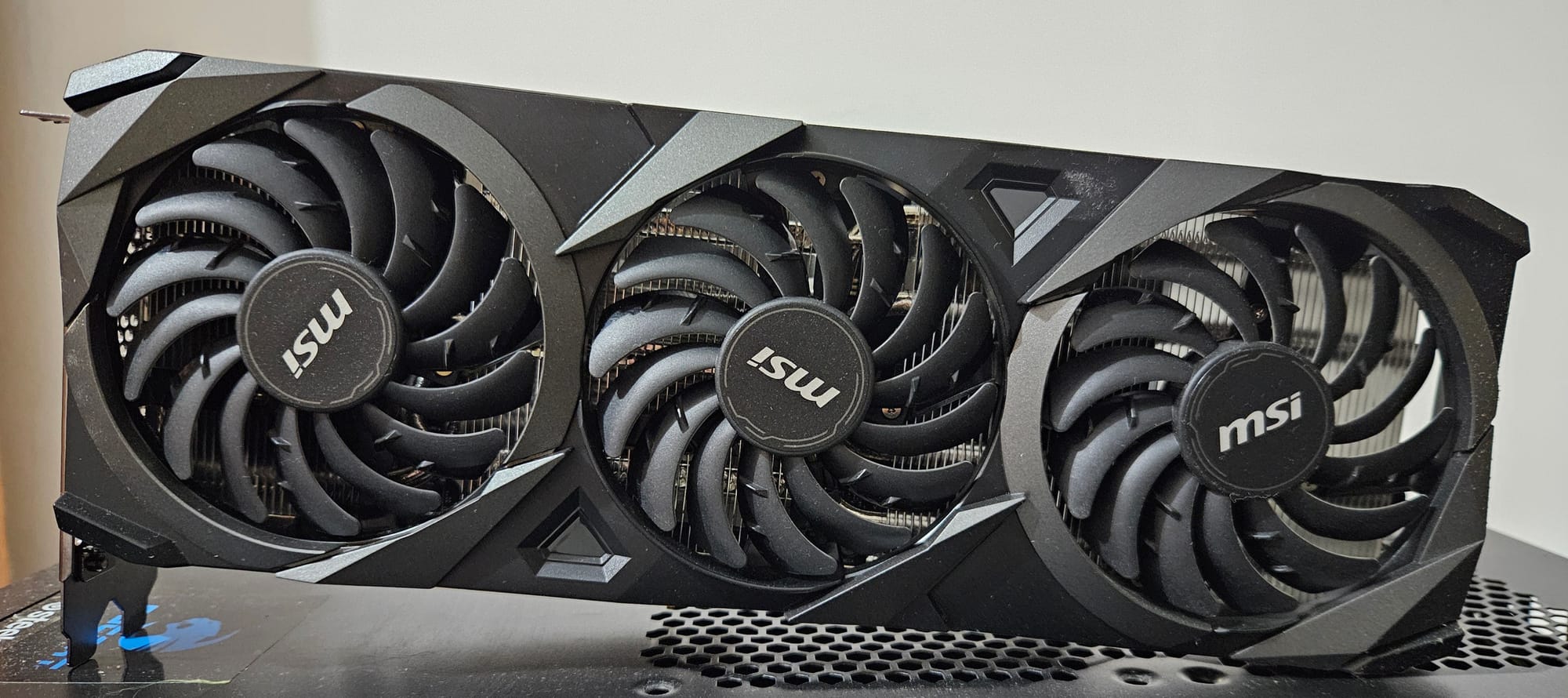
- Top picture: A graphics card with an NVIDIA GPU, shown for illustration. Inception states its speed figure for NVIDIA GPUs but does not name the GPU. Image: TheStriker, CC BY 4.0, via Wikimedia Commons
