Text from the Grok API is due to carry an invisible watermark from 7 November 2026, according to the company's own developer documentation. The page, headed "Output Watermarking", is marked "Last updated: October 31, 2026". The description of the watermark below is what that page says, so it is the company's account of its own system.
What the documentation says
The docs state that text responses from supported Grok models include an invisible watermark, one that lets SpaceXSI later recognise text as model-generated. They also say it requires no change to requests: there is no parameter to send, and an integration works the same way with or without it.
The page says that starting 7 November 2026, responses from seven models include the watermark, on by default:
- grok-4.7
- grok-4.6
- grok-4.5
- grok-4.3
- grok-4.20-reasoning
- grok-4.20-non-reasoning
- grok-4.20-multi-agent
According to the docs, the watermark covers ordinary text responses, structured outputs and tool-call arguments, across every text generation API, including the Responses API and the Chat Completions API. It is enabled on every SpaceXSI API endpoint, the page says, including the global endpoint at api.x.ai and any regional endpoint.
How it works, as described
The docs say the mark is applied while the model generates text, slightly shaping which tokens it picks, so it adds no characters, markup or hidden text to the response.
Detection is statistical. SpaceXSI scores a piece of text against the watermark and reports whether it is watermarked, not watermarked or uncertain, and the docs say longer text gives a stronger signal. Access to watermark detection is granted by application, through a form the page links to.
Developers can check a response themselves. The docs say that an x-watermark: true header on a Responses API or Chat Completions API response means the output was generated with the watermark. Any other value, or no header, means it was not.
The docs also say watermarking doesn't change response quality or speed. The page gives no measurements for it.
Opting out
The docs say watermarking is controlled per model for the whole team, and that team admins can turn it off for some or all models in the SpaceXSI Console. The setting applies to every API key on the team. Changes apply to new requests within 5 minutes, and every opt-in and opt-out is recorded in the team's audit log.
Opting out comes with a condition. The docs say it asks the team to confirm that an exception under applicable law applies to its use, and that the team is solely responsible for any marking, disclosure or other legal requirement. The page also says some models may be locked on for a team, in which case they cannot be switched off from the Console.
On the docs' account, then, the change is small for a developer: no parameter to add and one header to read. The decision that matters is whether to opt out, model by model.
The EU reason
The docs give the reason in one line: SpaceXSI watermarks text model output "to comply with the EU AI Act". The page names the Act but no specific article.
The European Commission's page on its Code of Practice on Transparency of AI-generated Content says the Act's Article 50 transparency obligations apply from 2 August 2026. It describes the providers' side as requiring that outputs of AI systems, including text, are marked in a machine-readable format and detectable as artificially generated or manipulated.

The Act also includes a transition for systems already on the market. Article 111(4), in the consolidated text on the Commission's AI Act Service Desk, says providers of AI systems generating synthetic audio, image, video or text content that were placed on the market before 2 August 2026 shall take the necessary steps to comply with Article 50(2) by 2 December 2026. The docs don't mention that provision.
Who is behind the docs
The documentation names the company SpaceXSI and its console uses the same name. xAI's own news page, dated 2 February 2026, says SpaceX announced that day that it had acquired xAI. The API address in the docs is still api.x.ai.
Sources
European Commission (2026) 'Code of Practice on Transparency of AI-generated Content', Shaping Europe's digital future, last update 19 October 2026, available at: https://digital-strategy.ec.europa.eu/en/policies/code-practice-ai-generated-content (Accessed: 4 November 2026).
European Commission AI Act Service Desk (2026) 'Article 111: AI systems already placed on the market or put into service and general-purpose AI models already placed on the market', consolidated text as at 27 July 2026, available at: https://ai-act-service-desk.ec.europa.eu/en/ai-act/article-111 (Accessed: 4 November 2026).
xAI (2026) 'xAI joins SpaceX', xAI, 2 February 2026, available at: https://x.ai/news/xai-joins-spacex (Accessed: 4 November 2026).
xAI / SpaceXSI (2026) 'Output Watermarking', SpaceXSI Docs, last updated 31 October 2026, available at: https://docs.x.ai/developers/advanced-api-usage/watermarking (Accessed: 4 November 2026).
Picture credits
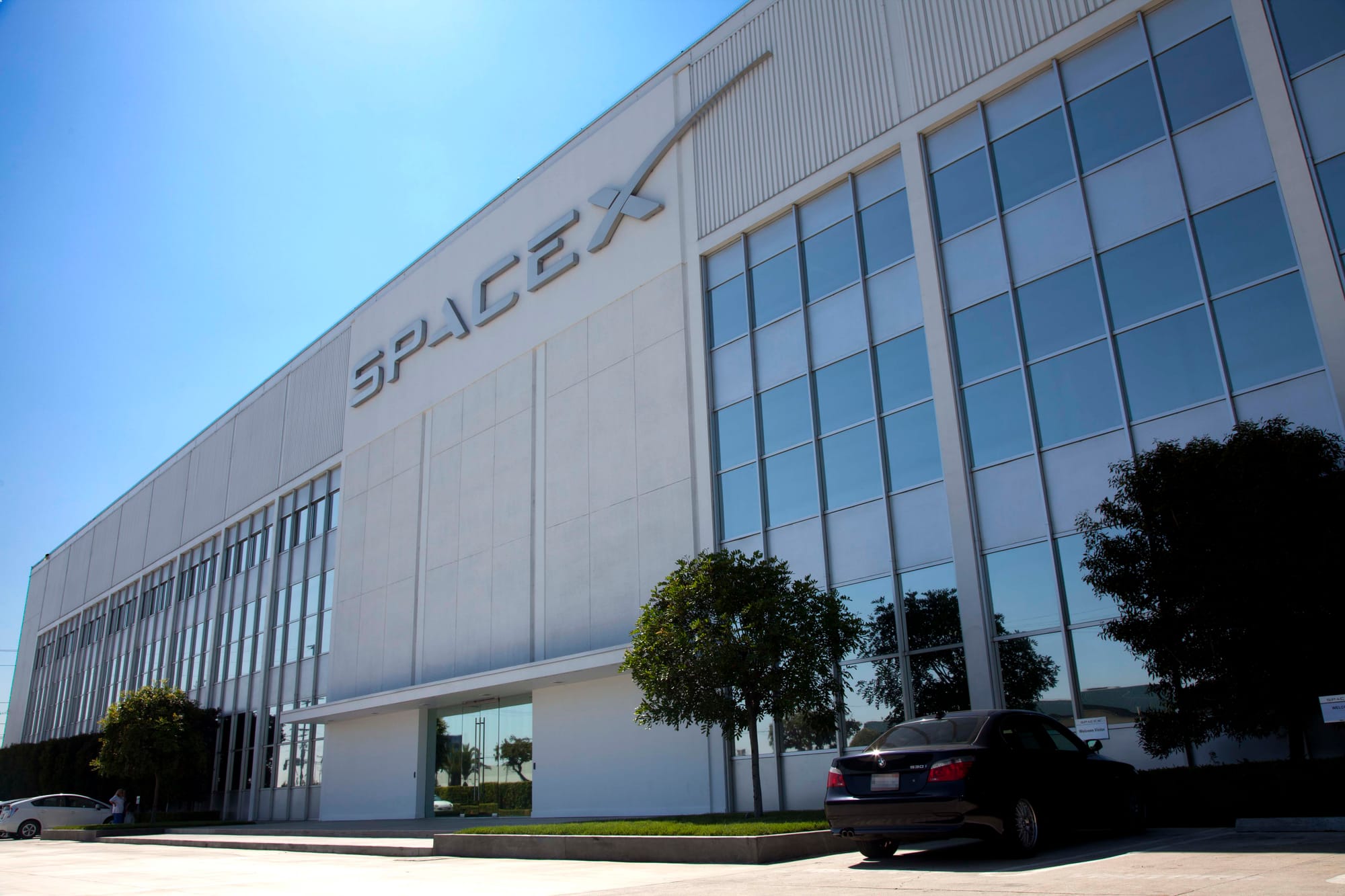
- Top picture: SpaceX's headquarters. The Grok API documentation now carries SpaceXSI branding. Image: SpaceX, CC0, via Wikimedia Commons
- Flags of EU member states outside the European Parliament in Brussels. Image: Marek Ślusarczyk (Tupungato), CC BY 3.0, via Wikimedia Commons

