Google says the prototype satellite it launched on 1 October for Project Suncatcher has now sent back an AI-generated poem. In a post dated 30 October, Travis Beals, Google's Senior Director, Paradigms of Intelligence, described it as the "Hello World" milestone: "the first-ever AI response from a data center class TPU in orbit."
That is Google's own claim about its own hardware. TechCrunch, reporting the same day, also described the satellite as online and communicating with the ground, and said a Google spokesperson told it the satellite was operating nominally. Neither report is independent testing of the claim.
What Google says happened
According to Google's post, the team spent the weeks after launch completing a commissioning checklist. That included powering up the host and TPU trays and running early machine-learning tests. This week, Google says, it uplinked its first prompt to the onboard Gemma 4 open model during a ground-station pass. The prompt asked for a haiku about being in space. As the satellite passed Svalbard, Norway, the poem came back down:
Blue marble below
Data streams in silent grace
Starlight feeds my core. ✨
Google says it then tested space-themed limericks and telemetry prompts that reported the technical status of the payload systems. TechCrunch described the commissioning as taking about three weeks.
The post says the next step is a series of tests of how the TPUs perform under thermal stress and radiation exposure in orbit. Google says that verifying its TPUs can reliably run workloads in space "paves the way" for its next milestone, twin interconnected satellites in 2027. It closes with the line "Our chips have officially earned their space wings — an important achievement on the long road ahead for this cosmic moonshot."
What the satellite is
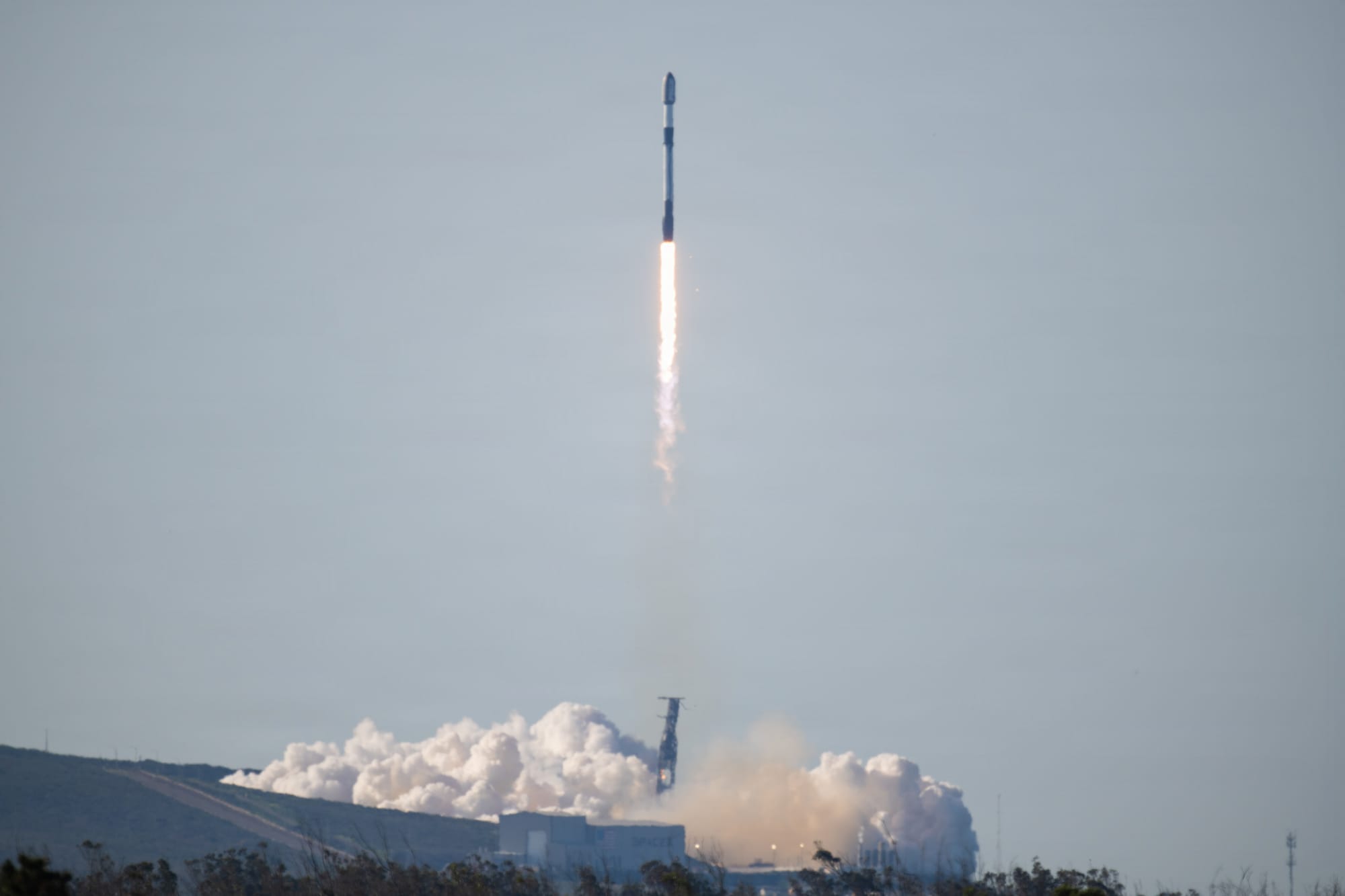
The prototype is about the size of a refrigerator, according to NPR. Google developed it in partnership with the satellite imagery company Planet. Planet's own launch announcement says it was developed in partnership with Google and describes it as the first-ever test of Google's Tensor Processing Units in space. It launched on 1 October on the Transporter-18 rideshare mission with SpaceX from Vandenberg Space Force Base, Planet said; CNN reported that the rocket was a Falcon 9.
NPR quoted Beals calling it "a very minimal test" to make sure the chips can run in space. NPR also reported that the goal is for the mission to be operational for a year.
The heat limit
NPR and Ars Technica said the chips can run for about 15 minutes at a time because of heat management constraints. A Google spokesperson gave CNN a slightly different figure, saying the test vehicle will "have to power down every 20 minutes, because we don't want it to overheat", and TechCrunch also put it at about twenty minutes.
Ars Technica describes cooling as perhaps the biggest issue, and NPR notes that on Earth heat can be dissipated with wind or water, which is not possible in the vacuum of space. Google's approach, as Ars Technica described it before launch, is to connect the chips to aluminium and copper heat pipes that carry heat to a radiator.
What has and hasn't been shown
A haiku shows that a prompt went up, a model ran and an answer came down. By Google's account, it is a "Hello World" milestone, reached after the commissioning checklist was complete. The tests the mission was built for, thermal stress and radiation exposure over time, are listed in Google's post as still to come.
On radiation, the evidence so far comes from the ground. In a research post dated 4 November 2025, Google Research said it tested Trillium, its v6e Cloud TPU, in a 67 MeV proton beam. It reported that the High Bandwidth Memory was the most sensitive component, with irregularities beginning after a cumulative dose of 2 krad(Si). That is nearly three times the expected shielded five-year mission dose of 750 rad(Si), Google Research said, and it reported no hard failures attributable to total ionizing dose up to the maximum tested dose of 15 krad(Si) on a single chip. That is Google's own testing, described in a preprint paper, and the orbital tests are meant to show how the hardware behaves in space itself.
"First" also needs its qualifier. NPR reported that a venture-backed startup, Starcloud, launched a spacecraft in November 2025 carrying an Nvidia H100 chip and demonstrated a version of Google's Gemini AI from space. Google's claim is narrower: the first AI response from a data-centre-class TPU in orbit.
The long road Google describes
Suncatcher is a long-range bet. Google's 2025 research post sets out a vision of solar-powered satellite constellations carrying TPUs and linked by free-space optical links. It says its analysis of historical and projected launch pricing suggests that, with a sustained learning rate, prices may fall to less than $200/kg by the mid-2030s, at which point the cost of launching and operating a space-based data centre could become roughly comparable to the reported energy costs of an equivalent terrestrial one on a per-kilowatt/year basis. The same post lists thermal management, high-bandwidth ground communications and on-orbit reliability among the significant engineering challenges that remain.
Beals was cautious about timing when he spoke to NPR. "I don't see this being something where it's cheaper to do this in the next five years. I think it will take longer than that," he said. Brandon Lucia, a professor of electrical and computer engineering at Carnegie Mellon University, told NPR that much of the technology has been proven at a research level. But he said repair is difficult when a data centre is circling hundreds of miles above Earth, and that the costs and complexity are "amplified by a factor of 10, maybe a factor of 100. And so there has to be a big payoff."
My reading is that the packaging is slightly ahead of the product. A haiku makes for a good headline, but Google's 30 October post lists the thermal and radiation tests on this satellite as its next step, and beyond them its own research names launch costs and engineering challenges.
Sources
CNN (2026) 'Google is firing the first salvo in a brewing race to deploy AI data centers in orbit', CNN, 1 October 2026, available at: https://www.cnn.com/2026/10/01/science/google-ai-data-center-satellites-space (Accessed: 30 October 2026).
Beals, T. (2026) 'We’ve received our first response from the Project Suncatcher prototype satellite.', Google, 30 October 2026, available at: https://blog.google/innovation-and-ai/models-and-research/google-research/project-suncatcher-satellite-response/ (Accessed: 30 October 2026).
Beals, T. (2025) 'Exploring a space-based, scalable AI infrastructure system design', Google Research, 4 November 2025, available at: https://research.google/blog/exploring-a-space-based-scalable-ai-infrastructure-system-design/ (Accessed: 30 October 2026).
Fernholz, T. (2026) 'Google's first data center satellite is online and writing poetry', TechCrunch, 30 October 2026, available at: https://techcrunch.com/2026/10/30/googles-first-data-center-satellite-is-online-and-writing-poetry/ (Accessed: 30 October 2026).
Planet Labs PBC (2026) 'Planet Launches Suncatcher, Tanager-2, and 18 SuperDove Satellites', Business Wire, via Yahoo Finance, 1 October 2026, available at: https://finance.yahoo.com/technology/articles/planet-launches-suncatcher-tanager-2-224200368.html (Accessed: 30 October 2026).
Ruwitch, J. and Brumfiel, G. (2026) 'Google launches Project Suncatcher, a step towards AI data centers in space', NPR, 1 October 2026 (corrected 2 October 2026), available at: https://www.npr.org/2026/10/01/nx-s1-5983697/project-suncatcher-google-ai-data-center-space (Accessed: 30 October 2026).
Whitwam, R. (2026) 'Google's first Suncatcher orbital data center test launches October 1', Ars Technica, 24 September 2026, available at: https://arstechnica.com/google/2026/09/googles-first-suncatcher-orbital-data-center-test-launches-october-1/ (Accessed: 30 October 2026).
Picture credits
- Top picture: A Falcon 9 launch from Vandenberg Space Force Base. This is an illustrative file picture of the launch site and vehicle type, not an image of the Suncatcher mission itself. Image: U.S. Space Force / 2nd Lt. Andrew Taller (source)
- Svalbard, Norway. Google says the satellite's poem was downlinked as it passed the archipelago; this is an illustrative picture of the place, not of the pass. Image: Buiobuione, CC BY-SA 4.0, via Wikimedia Commons

