
On Tuesday 3 November 2026, Google announced a change to how its AI products and Search are set up for school students. For K-12 student accounts, the products will be off until a school administrator switches them on. Critics, including two US senators, New York City's mayor and a former chair of the Federal Trade Commission, say the plan pressures schools into adopting AI. Google says it gives schools more control.
What Google announced
In a blog post dated 3 November, Chris Phillips, Google's VP and General Manager of Education, said the company was updating its approach to controls for Gemini, Gemini Notebook, Gemini in Classroom and Google Search. Access to these products, the post says, will be "entirely off for K-12 student accounts until school administrators explicitly turn them on."
The post says Google will share more specifics with schools "in the coming months ahead of the changes rolling out", so the controls described are an announced change rather than one already in place.
Google also announced Guided Learning features, which the post describes as step-by-step coaching rather than direct answers. According to the post, Guided Learning became globally available in Google Classroom on 3 November. A pilot in Search for select US schools is due to begin later in November, with expansion to other districts in the coming months. The post says "our research shows" that Guided Learning leads to measurable learning gains. That is Google's claim about its own product, based on its own research.
The Search question
Much of the criticism centred on what happens to Search at a school that does not want AI.
The Associated Press, via Boston.com, reported that students using Google software in the classroom would not be allowed to access Google's search engine unless their school system also opts in to AI. Because Search is integrated with AI, the AP wrote, schools that opt out of AI altogether would also lose access to Search.
CBS News and TechCrunch both carry a quotation from Phillips to The New York Times. TechCrunch quotes him saying that "Search and AI are deeply integrated". CBS reports him saying that schools that ban AI "will not have access to search, and they'll see a message from their school that indicates it's not available."
Google's own account, in an X post from its @NewsFromGoogle account on 3 November that set out to "clarify what we announced today", was framed differently. In it, the company wrote that Gemini, Gemini Notebook and Search "will be OFF" by default, and that schools "can choose to turn ON one, two, or all of these services individually." In the same post, Google described the announcements as giving schools "more choice, not less."
Google's X post says schools can choose to turn on Gemini, Gemini Notebook and Search individually, and that AI Mode and AI Overviews in school Search will offer step-by-step guided learning through problems.
The reaction
TechCrunch reported that Senator Bernie Sanders (I-VT) accused Google in an X post of "extortion", writing: "Google is threatening schools: if you stop your students from using AI, we will cut off your access to Google Search." It also reported that Senator Richard Blumenthal (D-CT) said on X that Google is "more concerned with forcing Gemini into schools than enabling students to succeed."
CBS News reported that New York City Mayor Zohran Mamdani accused Google of "trying to use its monopoly power to force AI into our public schools". He added: "No corporation should have the power to dictate how we teach our children." CBS reported that a Google spokesperson declined to respond to his remarks.
Lina Khan, who chaired the Federal Trade Commission from 2021 to 2025 and, according to CBS, now chairs the board of the New York City Economic Development Corporation, wrote on social media, as the AP reported: "Google is using its search monopoly to coerce schools into adopting AI." TechCrunch carries her further words: "Multiple courts have found Google liable for violating antitrust laws, and this latest move shows it remains unchastened." She also wrote, per CBS and the AP: "As the public increasingly pushes back against the use of AI in schools, Google is making clear it will punish those who don't fall in line."
Randi Weingarten, president of the American Federation of Teachers, said in a statement reported by CBS: "Instead of working with teachers and parents to uphold privacy and ensure their tools are safe and useful, it throws the baby out with the bathwater and bans access to the tools altogether."
Josh Golin, executive director of the children's advocacy group Fairplay, said, per the AP and CBS, that Google's attempt to "strong-arm schools into using its AI products is likely to backfire." He said Google's technology in schools is not about learning but about "developing lifetime brand loyalty" for its products.
Why schools are the battleground
CBS and the AP both report Google's own figure that roughly 150 million students and teachers use Google Classroom, and that many students use school-provided Chromebooks. TechCrunch notes that for students required to use Chromebooks and Google education tools, using a different search engine is not a simple fix.
The announcement follows an earlier row. CBS and the AP report that Google drew backlash in August when it activated its Gemini chatbot for many K-12 students; until August, Gemini had only been available to students aged 18 or older. CBS adds that in September, New York City schools said AI would be banned until students reach high school, with a one-year delay on generative AI for children from 2-K through eighth grade.
What to watch
Google said Gemini, Gemini Notebook and Search will be off by default for K-12 student accounts until school administrators turn them on. The Associated Press reported: "But because search is integrated with AI, schools that opt out of AI altogether would also lose access to Google search."
Sources
Cerullo, M. (2026) 'Google will block search access for schools that ban AI use', CBS News, 3 November 2026, available at: https://www.cbsnews.com/news/google-search-access-schools-ai-tools/ (Accessed: 4 November 2026).
Chen, M. (2026) 'Google Softens School Search Rule, Options Due 2027', Tech Insider, 4 November 2026, available at: https://tech-insider.org/google-softens-school-search-rule-ai-ban-backlash-2026/ (Accessed: 4 November 2026).
News from Google (2026) 'We want to clarify what we announced today about our education services', X (@NewsFromGoogle), 3 November 2026, available at: https://x.com/NewsFromGoogle/status/2117714815477059722 (Accessed: 4 November 2026).
Ortutay, B. (2026) 'Google will cut off search access for students at schools that reject AI', Associated Press via Boston.com, 4 November 2026, available at: https://apnews.com/article/ai-schools-classroom-students-google-7ba4219e505db1c11d672f6eefe7155a (Accessed: 4 November 2026).
Phillips, C. (2026) 'Designing responsible AI for learning', Google, 3 November 2026, available at: https://blog.google/products-and-platforms/products/education/ai-learning-era-updates-2026/ (Accessed: 4 November 2026).
Silberling, A. (2026) 'Google faces backlash for plan that would turn off Search for schools that restrict AI', TechCrunch, 4 November 2026, available at: https://techcrunch.com/2026/11/04/google-faces-backlash-for-plan-that-would-turn-off-search-for-schools-that-restrict-ai/ (Accessed: 4 November 2026).
Picture credits
- Top picture: Google's headquarters in Mountain View, California. Photo: Carol M. Highsmith / Library of Congress (public domain) (source)
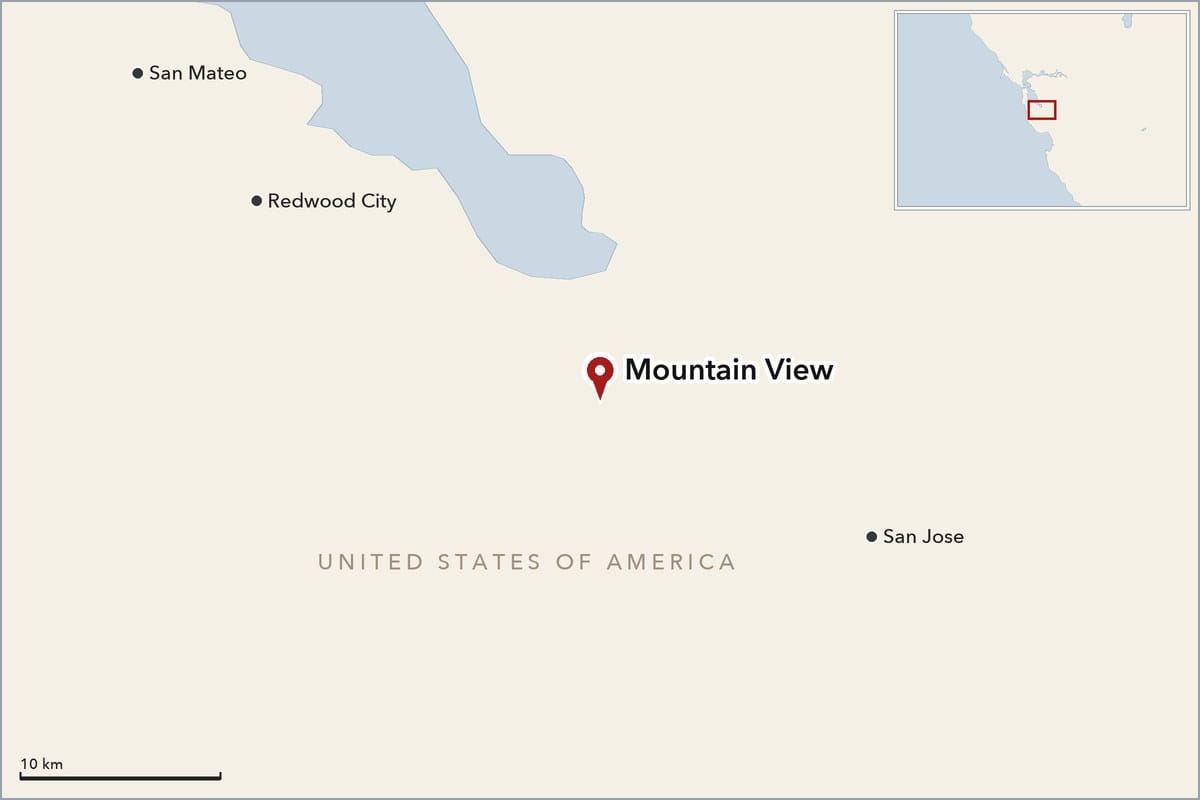
- Map: drawn from Natural Earth (public domain) and Wikidata.