On 27 October 2026, Google DeepMind announced Genie 4, the latest in its line of world models. The pitch is a simulated world you can steer as it plays, and one that makes its own sound. Everything below is DeepMind's account of its own model: it is an announcement with demo recordings, not an independent test, and it is a research preview rather than a product anyone can sign up and use.
What DeepMind says Genie 4 does
DeepMind's announcement post, written by Raia Hadsell, Diego Rivas and Hang Qi, says Genie 4 "unlocks unprecedented realism and improves real-time interactive simulation". Google's own post says the model brings "unprecedented realism and native audio". These are Google's own characterisations, illustrated with demo recordings.
DeepMind's post lists four capabilities, which are described below.
Live steering. Users move around with standard keyboard controls and steer the scene with text prompts as it unfolds. DeepMind says you can change the weather, move the camera, or introduce a new person or object, and that Gemini adapts the prompt to fit the surrounding scene. Between inputs, the post says, Gemini also monitors the scene and steers it so the world keeps progressing coherently.
Physics and people. The post says Genie 4 simulates real-world physics scenarios, such as aerodynamics and collisions. DeepMind calls its handling of people "the most dramatic leap", saying characters move naturally, respond to their surroundings and can be steered in real time.
Native audio. DeepMind calls Genie 4 its first real-time world model to generate audio natively, with each world carrying the ambient sound of its setting. The post also describes interactive dialogue, in which characters talk and react to the user's inputs or to events in the world. DeepMind says the sounds in the clips at the top of its post are produced directly by Genie 4.
Gemini in the loop. DeepMind says Genie 4 builds on the Gemini family: Gemini Omni anchors simulations in real-world appearance and behaviour, while other Gemini models supply reasoning to keep a simulation coherent. For multi-step events, the post says Gemini 3.8 Flash acts as a guiding agent. As Genie 4 generates the world, Gemini watches the scene, breaks goals into steps and reviews incoming frames to check that each step worked.
A robotics demo
DeepMind also says it has been experimenting with Gemini 4 Argon and Genie 4 together, alongside Gemini Robotics. In the example it shows, Argon breaks a user's task into steps that are fed to Genie 4 as text captions while the simulation renders. The demo shows a simulation of Apptronik's Apollo humanoid playing checkers.
This is a demonstration of a simulated robot, shown by the company that built the system. The post presents it as exploratory work.
Announced, shown, shipped
The three words matter here. Genie 4 has been announced and shown in recordings that DeepMind describes as real-time interactions. On access, DeepMind's wording is that it has started rolling Genie 4 out as a research preview to trusted testers, to gather feedback before releasing it to consumers and developers. Google's post describes the group as "a limited group of trusted testers".
The planned next step, in Google's post, is that Genie 4 is coming soon to Google AI Ultra subscribers in Project Genie, and to early access partners in the Gemini API and AI Studio. DeepMind's post invites readers to join a waitlist for Genie 4 in Project Genie. Google's post gives no date for that wider access.
DeepMind says it has worked with cohorts of trusted testers across creative industries, journalism, education, gaming and engineering. The uses it reports from them include:
- filmmakers running multiple "takes" of a live scene;
- photojournalists turning a single archival photograph into a simulation of that environment;
- game developers moving from an idea to an explorable prototype;
- enterprise partners evaluating it for scenario generation.
Those are DeepMind's summaries of what testers are doing. The post gives no count of testers.
The limitations DeepMind lists
DeepMind describes Genie 4 as "an early, experimental model". Its own limitations section says the model can keep environments coherent over short sessions, but that visual details and object permanence can shift or drift over time. It says this happens especially as a simulation runs longer, after several complex prompt edits, or when navigating through the scene.
DeepMind also lists complex physical interactions, real-time audio accuracy, rendering legible text, spatial accuracy and long-term consistency as active areas of ongoing research. That sits awkwardly beside the headline claim of unprecedented realism, and the post offers no figures that would let a reader weigh one against the other.
Safety and provenance
On safety, DeepMind says Genie 4 includes strict safety guardrails consistent with its policies for other models, and that it ran internal safety evaluations before launching the preview. It says it deployed the model first to trusted testers to gather early feedback. These are the company's statements about its own evaluations. The post does not describe those evaluations in detail.
It also says all video and audio generated by Genie 4 will carry SynthID, its imperceptible watermarking technology for identifying AI-generated content across visual and audio. That matters for a model whose demos are built to look like footage.
Where it sits in DeepMind's thinking
DeepMind frames world simulation as part of the path to AGI, saying understanding and simulating the world is a crucial aspect of building it. Google's post lists safe training environments for robots and agents, and creative tools in filmmaking, journalism, gaming and manufacturing, as uses.
DeepMind's post also sketches what it calls hybrid world models. These would combine the structured reasoning of code and language models with pixel-level simulation, and the post describes pairing Genie with Gemini as an early step in that direction.
For now, Genie 4 is a set of demos and a waitlist. The claims are DeepMind's, and the tester group is what Google calls limited. What happens when more people can try it is the part still to be seen.
Sources
Google (2026) 'We're announcing Genie 4, our new world model for real-time interactive simulation.', blog.google, 27 October 2026, available at: https://blog.google/innovation-and-ai/models-and-research/google-deepmind/introducing-genie-4/ (Accessed: 30 October 2026).
Hadsell, R., Rivas, D. and Qi, H. (2026) 'Genie 4: A new generation of world simulation', Google DeepMind, 27 October 2026, available at: https://deepmind.google/blog/genie-4-a-new-generation-of-world-simulation/ (Accessed: 30 October 2026).
Picture credits
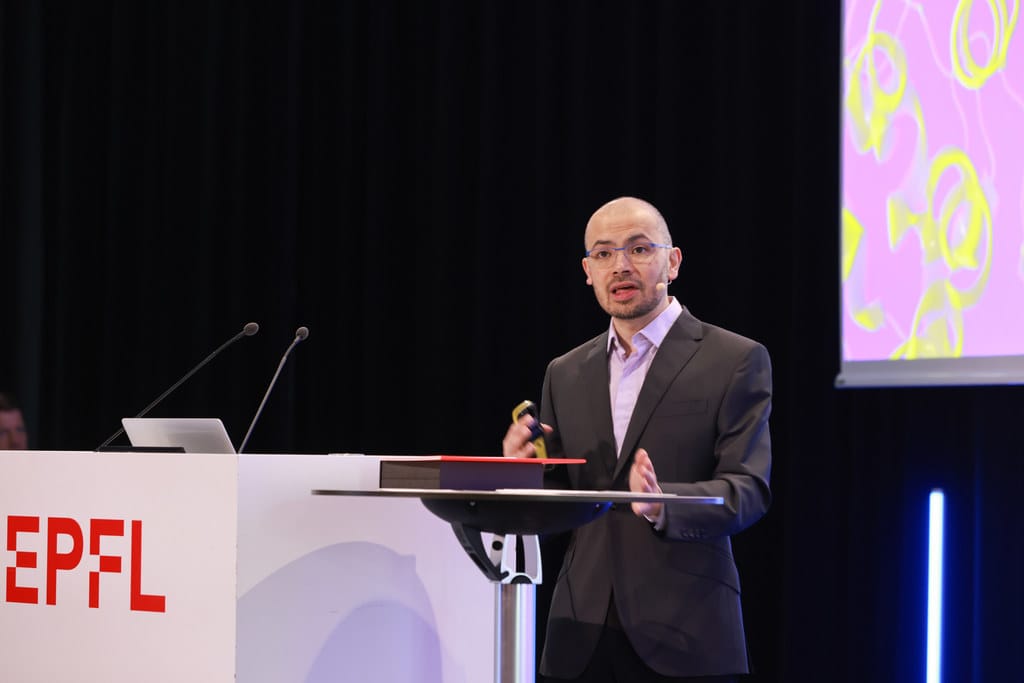
- Top picture: Demis Hassabis giving a campus lecture at EPFL, 26 May 2023. Photo: Alain Herzog, CC BY-SA 4.0 (source)
