Google has announced Gemini 4 Argon, a new frontier model. The announcement and a Bloomberg report on the same day, 30 September 2026, describe two different pictures of it. Google's post, written by Koray Kavukcuoglu, SVP of Google DeepMind and Chief AI Architect, presents a model with leading benchmark scores. Bloomberg, citing anonymous people familiar with the work, reports that employees are sceptical of how it performs on real tasks. Google disputes part of that account.
What Google announced
Google says Argon is "rolling out to a set of trusted cyber defenders through our Fairwind Program". Wider access to developers, enterprises and consumers will come "as soon as possible", and paid API customers and Google AI Ultra subscribers are named as first in line. Google says it is "actively engaged in the U.S. government's voluntary process for pre-release model access" while it expands access in phases.
Google gives these terms and capabilities:
- Pricing: an introductory $2 per million input tokens and $10 per million output tokens, with cached input tokens at 95% off the input price. After the introductory period the prices become $4 and $20.
- Output limit: raised to 1 million tokens, up from 64,000.
- Positioning: Google describes the model as delivering frontier performance in real-world software engineering, enterprise knowledge work such as legal and finance, and cybersecurity defence.
Google's performance claims
All of the figures below are Google's own, taken from its post and its Fairwind page:
- A new state of the art on DeepSWE v1.1 (77.9%).
- A lead on the Vals Index.
- First place on Zapier's AutomationBench (51.3%).
- A state-of-the-art 91.7% on LVBench, a long-video-understanding test.
- A tie for first on CWE-bench v1 (68%), a test of remediating security vulnerabilities.
Google also describes internal uses. In one quantum-computing example, it says Argon beat a published baseline by 40%. In another, it says a team of Argon agents found memory optimisations across its data centres that would free up over 300 TiB once rolled out. It also says Argon agents took an existing Rust port of the libgav1 video decoder and replaced 32,000 lines of SIMD code, producing a memory-safe decoder that runs 2.7 times faster than that Rust port.
On security, Google says Wiz is using Argon through its Scan for Good initiative. In what Google calls an early demonstration, the model "uncovered a critical vulnerability exposing sensitive personal information across healthcare software used by hospitals worldwide". Google says previous frontier models had missed it.
Google says trusted defenders and its own internal teams will get Argon "without cyber guardrails". For wider release it lists four areas of safeguards: misuse prevention under its Frontier Safety Framework, resistance to indirect prompt injection, monitoring for misalignment, and hardened sandboxed environments.
Who gets access through Fairwind
Google DeepMind's Fairwind page says the programme gives high-priority defenders, such as governments, healthcare providers and telecommunications services, early access to advanced models. It says it currently works with over 650 partners globally, and that a set of them have exclusive access to Argon, including through its CodeMender security agent.
The page lists conditions for partners:
- Only dual-use tasks are permitted, such as authorised threat simulation, reverse engineering and malware analysis for defensive and academic research. The page says malicious tasks such as creating malware are not permitted.
- Participating organisations agree to terms including user-level authentication and phishing-resistant MFA, and may give Argon access only to internal cybersecurity, incident response or penetration-testing teams.
- Partners may not share, redistribute or sell access.
- The page says Google DeepMind conducts background checks on organisations that apply.
The page also says that when Argon is accessed directly as a managed model on Gemini Enterprise, it supports zero data retention.
What Bloomberg reports
Bloomberg's Julia Love and Davey Alba write that Gemini 4 has performed well on industry benchmarks but "does less well when employees actually put it to work", according to people with direct access to the effort. Those people, who asked not to be named, said the model struggles with certain coding tasks. People familiar with its internal evaluations described its coding abilities as uneven, and one person said it is not particularly adept at front-end design.
Bloomberg also reports that:
- Google had planned a Gemini 3.5 Pro release for June, after announcing it at its I/O conference in May, but abandoned the effort, according to people familiar with the matter.
- Two people familiar with the model said it appears to be affected by what Bloomberg calls "benchmaxxing": engineers concentrating more on achieving a good score than on creating a product that does a job well.
- Opinion inside Google is split. Some employees believe Anthropic's Fable and OpenAI's Astra models are improving faster than Gemini and that Gemini 4 will still lag them in some areas. Others believe it has caught up with the leading labs.
- A Google employee familiar with model development said there is "large consensus" internally that Gemini 4 is at the frontier, and denied that the models struggle with messy, real-world coding tasks.
- Gemini 4 does have strengths, according to a person familiar with the matter, who pointed to making sense of non-text inputs such as extracting metadata from video, along with safety, cybersecurity and clear, natural communication.
Google told Bloomberg it would be inaccurate to say Gemini 4 is underperforming in areas such as coding. It pointed to remarks by Kavukcuoglu at a conference hosted by The Information, where he said: "In my mind, it's a certainty that we are always gonna be at the frontier."
Announced, shown, shipped
Google's post is an announcement with vendor-reported benchmarks. In its 30 September post, Google said Argon was rolling out first to trusted cyber defenders, alongside trusted testers and Google's own teams, and its wording for wider availability was "as soon as possible". Bloomberg's reporting rests on anonymous sources and a company rebuttal, and the benchmark-chasing point is the assessment of two unnamed people, not a measured finding.
My reading is that the two accounts are not directly comparable. Google's figures are scores on named tests. Bloomberg's sources are describing day-to-day use inside the company. Wider access, starting with the developers and customers Google names as next, is what will let its performance be tested beyond these two accounts.
Sources
Google DeepMind (n.d.) 'Fairwind Program', Google DeepMind, available at: https://deepmind.google/fairwind-program/ (Accessed: 13 October 2026).
Kavukcuoglu, K. (2026) 'Gemini 4 Argon: our next era of frontier intelligence', Google, 30 September 2026, available at: https://blog.google/innovation-and-ai/models-and-research/gemini-models/gemini-4-argon/ (Accessed: 13 October 2026).
Love, J. and Alba, D. (2026) 'Google Grapples With Employee Skepticism About New Gemini Model', Bloomberg, 30 September 2026, via Yahoo Finance, available at: https://finance.yahoo.com/technology/ai/articles/google-grapples-employee-skepticism-gemini-195242680.html (Accessed: 13 October 2026).
Picture credits
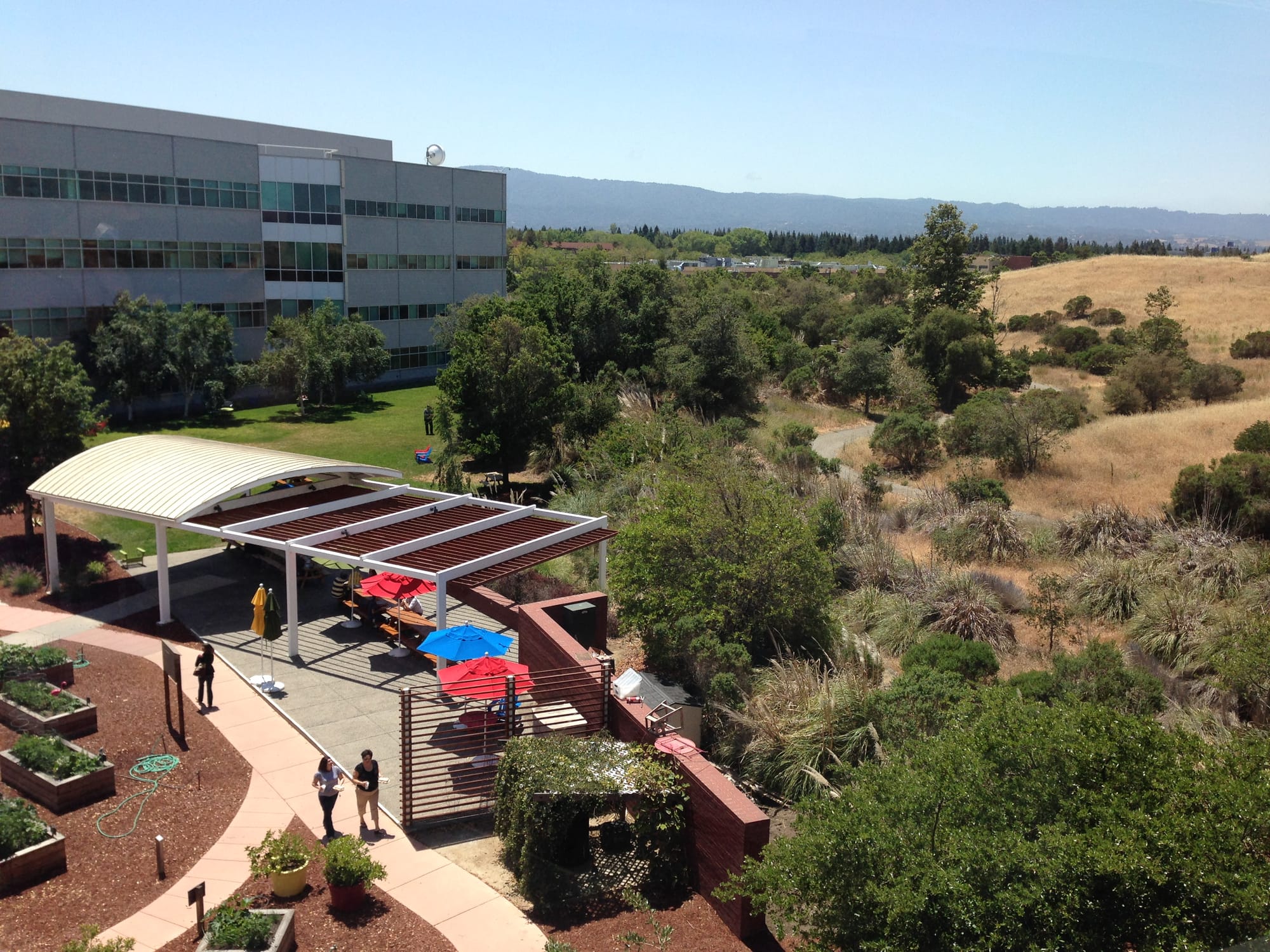
- Top picture: Google's headquarters. Google Building CL2 (Googleplex), Mountain View — photo by Runner1928, CC BY-SA 3.0, via Wikimedia Commons
