On 20 October, Anthropic and the investment research firm Citrini Research each published an account of the same experiment. An unreleased Claude model had been asked to design small proteins that attach to scorpion neurotoxins. Anthropic's page states its result plainly: "We have not confirmed whether these binders neutralize scorpion venom in a cellular environment, so we do not claim to have produced an antivenom."
Two days later The Verge reported on the project under the headline "Claude did not invent scorpion antivenom". Here is what the two primary accounts say was done, what the lab tests found, and how outside experts read it.
What was asked of Claude
Anthropic says it asked an internal research model to design minibinders, which it describes as small proteins that attach tightly to a target. The targets were scorpion neurotoxins. Anthropic says it hoped such binders could one day be used to develop a scorpion antivenom.
The company gives the scale of the problem: scorpions sting 1.2 million people or more every year, causing more than 3,250 deaths, mostly among children in places with limited access to medical care. It says new treatments are expensive to make and unlikely to earn back their development costs.
Per Anthropic, the model worked on the task for 64 hours, mostly autonomously. It was given one prompt and four follow-ups, all developed with Citrini. Anthropic says the team chose five toxins from scorpions in four regions: Mexico (Cn2), Brazil (Ts1), North Africa (AaH I and AaH II) and the Middle East (LqhIII). Anthropic says the work used on the order of 10,000 GPU hours.
How an investment newsletter ended up in the lab
Citrini's own post sets out the background. The firm says five of its staff took part, three of them with "no background whatsoever in science". It also says that "none of us could claim to know anything about AI as it related to biology". The Verge reports that Citrini wanted to prove AI could revolutionise drug development.
Citrini says its first attempt on its own ran straight into the model's biosecurity restrictions: "We were immediately guardrailed." Anthropic responded to its request to bypass the bio-classifier, it says, with a questionnaire of "more than 60 questions about security measures that we absolutely did not have". The agreed alternative was to do the prompting "in person, at the Anthropic offices, on their local network and machines", using an internal research model that Citrini describes as more advanced than the publicly released ones.
Citrini says it budgeted $200,000 of its own money for compute, tokens and lab work. It says compute came to $49,997 and that Anthropic "was willing to play ball on the compute/token bill"; The Verge reports that Anthropic footed that bill, which came just shy of $50,000. Citrini says the bill from the two contract labs came to just shy of $150,000.
What the lab tests found
Anthropic says Claude generated 318,484 protein designs and selected 180 of them for testing. The team added 31 more with Claude's help, making 211. Two contract research organisations, Adaptyv Bio and Twist Bioscience, tested all 211 for binding to the toxins they were designed against.
Anthropic set strict criteria for calling a design a binder:
- It had to be a hit at both labs, with binding shown in every replicate.
- Every binding-strength measurement (KD) had to be 1 µM or tighter.
- It had to show no signal against CLEC12A, an unrelated human protein used to check for "stickiness".
Anthropic adds that LqhIII was assessed only by Adaptyv Bio.
Seventeen designs met those criteria. Anthropic reports seven binders against Cn2, four against AaH II, four against AaH I and two against LqhIII. Each bound a single toxin.
Among the 60 designs aimed at a single toxin, 11 were binders, which Anthropic puts at 18% and calls consistent with typical protein design campaigns, including its own previous work. The multitoxin attempt did not work. Anthropic says 91 of the designs were aimed at all five toxins, and none of the multitoxin designs met its criteria for more than one toxin. Citrini adds that Claude had warned that a single molecule binding all five was very likely to fail. Anthropic notes several possible explanations for the multitoxin result, including its own prompting, the limits of the design tools and the biological feasibility.
The strongest results were two binders against Cn2, called Cn2-B1 and Cn2-B2. Anthropic says each bound Cn2 tightly at both labs, with affinities in the single-digit nanomolar range. Its competition experiments suggest they attach on or near the same site as an antibody called LR, which Anthropic says has been reported to neutralise Cn2 in mice. Anthropic reasons that "the fact that they compete with LR suggests that they will likely neutralize Cn2". It adds that it has not tested the two binders in a cellular environment or in live animals.
Anthropic also writes: "To our knowledge, no de novo-designed binders against scorpion neurotoxins have been described." It says it is releasing all 211 designs and their data.
The gap between binding and a medicine
Anthropic names two main limitations of the study. It did not test any design for neutralisation in cells grown in the lab, and it did not test any for efficacy in living animals. Its results also cover only recombinant toxins, which are grown from each toxin's gene rather than purified from venom. For the next steps, it says it would confirm binding to toxin purified from venom, run patch-clamp recordings to see whether a binder stops the toxin acting on the sodium channel, and then test in mice.
Citrini says the same in its own words: "No experiment has yet tested whether they actually stopped the toxin working."
What outside experts said
Anthropic sent Claude's work to two outside experts, Susana Vázquez Torres and Timothy P. Jenkins, and says they felt it was "a promising first step". Vázquez Torres, a postdoctoral researcher at the Spanish National Cancer Research Centre (CNIO) in Madrid, is quoted on Anthropic's page as saying that "the real impact will come from tackling the parts of the therapeutic pipeline that go beyond binding". Jenkins, an associate professor at the Technical University of Denmark, is quoted there calling designing credible binders against five toxins in parallel, in days, "a great showcase of the AI-driven paradigm shift we are seeing in therapeutic discovery".
The Verge spoke to a different set of experts, who were more guarded. Andreas Hougaard Laustsen-Kiel, a professor of antibody technologies at the Technical University of Denmark, told it: "It is easy-ish to discover a good binder against snake and scorpion toxins." The hard part, he said, is "to translate it into a medicine."
Melisa Benard Valle and Anne Ljungars, also of the Technical University of Denmark, wrote in a joint email: "The results are technically promising, but some of the excitement is premature." They described the findings as "far from a medicine and hyped". They said the most novel aspect was the "autonomous discovery process rather than the biological results".
Andreas Bender, a professor of machine learning in medicine at Khalifa University in Abu Dhabi, told The Verge that existing methods such as high-throughput screening "are often able to find a multitude of hits at manageable cost" without AI. He said designing proteins that bind targets is "kind of" a solved problem, adding: "It's exactly this translation that lacks."
The framing around the result
The Verge concluded that "the experiment had not succeeded", since Citrini set out to make a new drug. It reports that Citrini nonetheless declared the experiment a success of sorts, arguing it offers a glimpse of the investment opportunities in AI-enabled drug discovery. According to The Verge, Citrini accused critics of "nitpick[ing]" and added: "Not to beat a dead horse, but we are an investment research firm - not a biotech startup."
The Verge notes that the specifics of Citrini's investment case were reserved for paying subscribers. The Verge also notes that Anthropic, which it describes as "mere weeks out from its hotly anticipated IPO", "has a few reasons to talk up AI's potential in drug development and the life sciences". It reports that Citrini and Anthropic did not respond to its requests for comment.
My own reading: the Anthropic page is open about its main limitation, and that makes the exchange easier to judge. The disagreement is over how much a binding result is worth, not over what the lab data showed.
Sources
Anthropic (2026) 'How Claude designed protein binders against scorpion neurotoxins', Anthropic, 20 October 2026, available at: https://www.anthropic.com/research/claude-scorpion-toxin-binder-design (Accessed: 22 October 2026).
Citrini Research (2026) 'Citrini Therapeutics: We Wanted to Use Claude to Create a New Drug. Here's What Happened.', Citrini Research, 20 October 2026, available at: https://www.citriniresearch.com/p/citrini-therapeutics (Accessed: 22 October 2026).
Hart, R. (2026) 'Claude did not invent scorpion antivenom', The Verge, 22 October 2026, available at: https://www.theverge.com/ai-artificial-intelligence/1016443/anthropic-claude-citrini-vibecoding-scorpion-antivenom (Accessed: 22 October 2026).
Picture credits
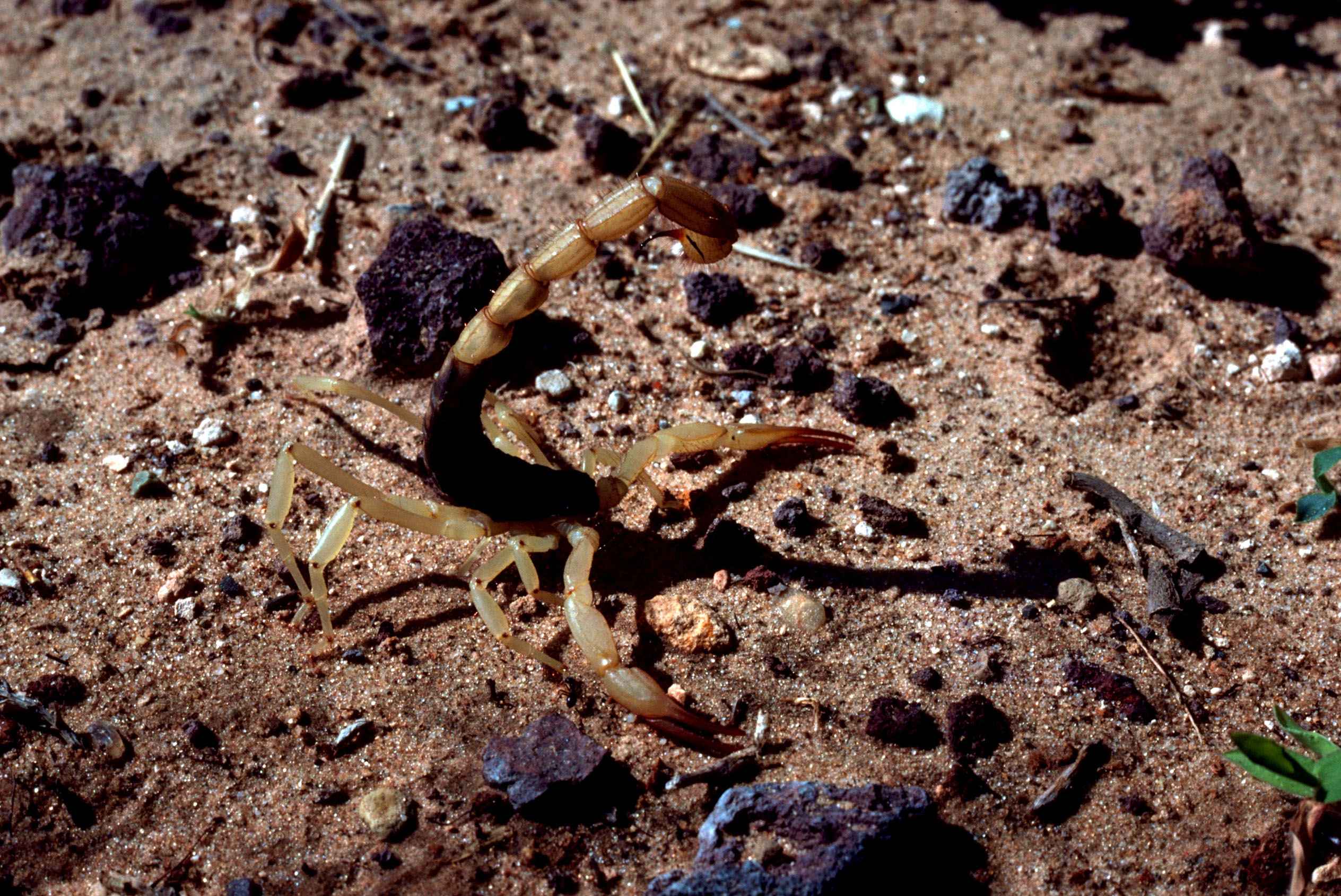
- Top picture: A bark scorpion (Centruroides). Image: Stolz Gary M, U.S. Fish and Wildlife Service (public domain) (source)
