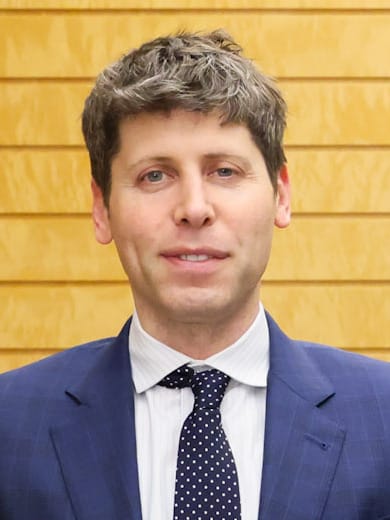
Sam Altman has said he sympathises with mathematicians struggling to keep up with OpenAI's results, but that the world deserves the knowledge. He made the remarks on an episode of the Cheeky Pint podcast, hosted by John Collison and released on 29 October 2026. The Verge's Robert Hart reported on 30 October that Altman has no intention of stopping. Hart described the comments as one of the first times the OpenAI chief has directly acknowledged the company's impact on mathematicians.
What Altman said
Collison put it to Altman that he might be "too contrite" about the reaction from mathematicians. Altman's reply was: "I think, on net, the world deserves to understand how the universe works. But I do have empathy for the method."
He went further on the principle. "I feel unequivocal on this point: Humanity deserves fundamental knowledge," he said. He added that "we should not be sitting on a major fundamental science discovery". He set this against what he called "another very important equity": that a scientist's career, and much of their fulfilment, comes from discovering science. He said OpenAI more than owes it to people in those fields to work out how the world can benefit from the knowledge while they "get the best version of the future that they can have". "So we are working through that right now," he said.
Altman also described a weekend when OpenAI got a new model. The channel where staff posted problems was called "Model Name-Hold My Beer", he said, and people "were just throwing that at the hardest problems they could". He described the model "knocking down one after the other" of people's hardest research problems from their academic careers. He said he was up most of two nights because he was too excited to sleep. He also said he felt "much more sadness and melancholy, and a feeling of something ending" than he had expected. The Verge describes the channel as an internal Slack channel.
On whether OpenAI has more results than it has published, Collison asked: "We have more than the 700 proofs?" Altman answered: "We do. Of course." The Verge's report phrases the question as whether the company has more than the "hundreds of proofs" it has already released.
The money
Asked what the maths cost, Altman answered: "Order $10 million per... For Navier-Stokes, I think." He added: "Maybe a little more." He said OpenAI spent "way less than that on the average one of those". When Collison suggested "like 100s of millions of dollars of math", Altman replied "Yeah. Yeah, yeah. That kind of work." He added that the total "includes much more other discovery than what we have published". These are Altman's own estimates, given in conversation.
He also said the cost of the work was allowed to run. "We did let it get out of control for one week on the math," he said, "Intentionally so". His reason: "You don't know how far it's going to go until you try." He said that when OpenAI produced what it claims is a Navier-Stokes proof, "we understood absolutely nothing about the scaling laws of teams of agents". He added: "I bet we could redo Navier-Stokes at 1/100th of the cost a year from when it was done." That is Altman's expectation, not a result. The Verge describes the Navier-Stokes problem as one of mathematics's Millennium Prize problems.

What mathematicians told The Verge
The Verge reports that mathematicians it spoke to have repeatedly criticised how OpenAI announces results. They cite inadequate attribution, little context and insufficient verification. According to The Verge, researchers say this has left them doing the painstaking work of checking and making sense of the findings while the company presses ahead. The Verge also reports that OpenAI has released hundreds of mathematical results in October, often with brief writeups that researchers have described as poorly written and hard to follow.
The Verge adds that OpenAI is now being criticised for what Altman says it should not do: sitting on potentially significant findings. It says mathematicians and scientists it spoke to in the week of its report are frustrated by what they see as gatekeeping, following OpenAI's announcement of three major breakthroughs in mathematics, physics and computer science. Details of one of those claimed results, involving Yang-Mills theory, have not been released publicly, The Verge reports. OpenAI says this follows the recommendations of a hand-picked group of experts it consulted on how best to release the result. The Verge says this runs counter to the advice of a previous group of mathematicians the company consulted, but forms part of what the company says is a new approach to communicating its findings.
The Verge also reports that the scale of spending raises concerns among researchers that they may be priced out of their own fields.
A principle and a process
My view is that two arguments are being run together here. Altman's is about principle: that new fundamental knowledge should not be held back. The criticism The Verge reports is about process: attribution, context, verification, and what is and is not released. He can hold the first and still be open to the second. By his own account, OpenAI is "working through" how to do this.
Sources
Cheeky Pint (2026) 'Why Sam Altman is against a single superintelligence (Episode #39)', Cheeky Pint, 29 October 2026, available at: https://cheekypint.transistor.fm/39 (Accessed: 30 October 2026).
Cheeky Pint (2026) 'Why Sam Altman is against a single superintelligence' [transcript], Cheeky Pint, 29 October 2026, available at: https://cheekypint.transistor.fm/39/transcript (Accessed: 30 October 2026).
Hart, R. (2026) 'Sam Altman sympathizes with mathematicians, but says OpenAI's math onslaught won't stop', The Verge, 30 October 2026, available at: https://www.theverge.com/ai-artificial-intelligence/1023054/altman-cheeky-pint-ai-math-interview (Accessed: 30 October 2026).
Picture credits
- Top picture: Sam Altman, chief executive of OpenAI. Image: Sam Altman, Office of the Prime Minister of Japan, CC BY 4.0 (source)
- 1515 Third Street in San Francisco, a building that has housed OpenAI's offices. Photo: Coolcaesar, via Wikimedia Commons (CC BY 4.0)

